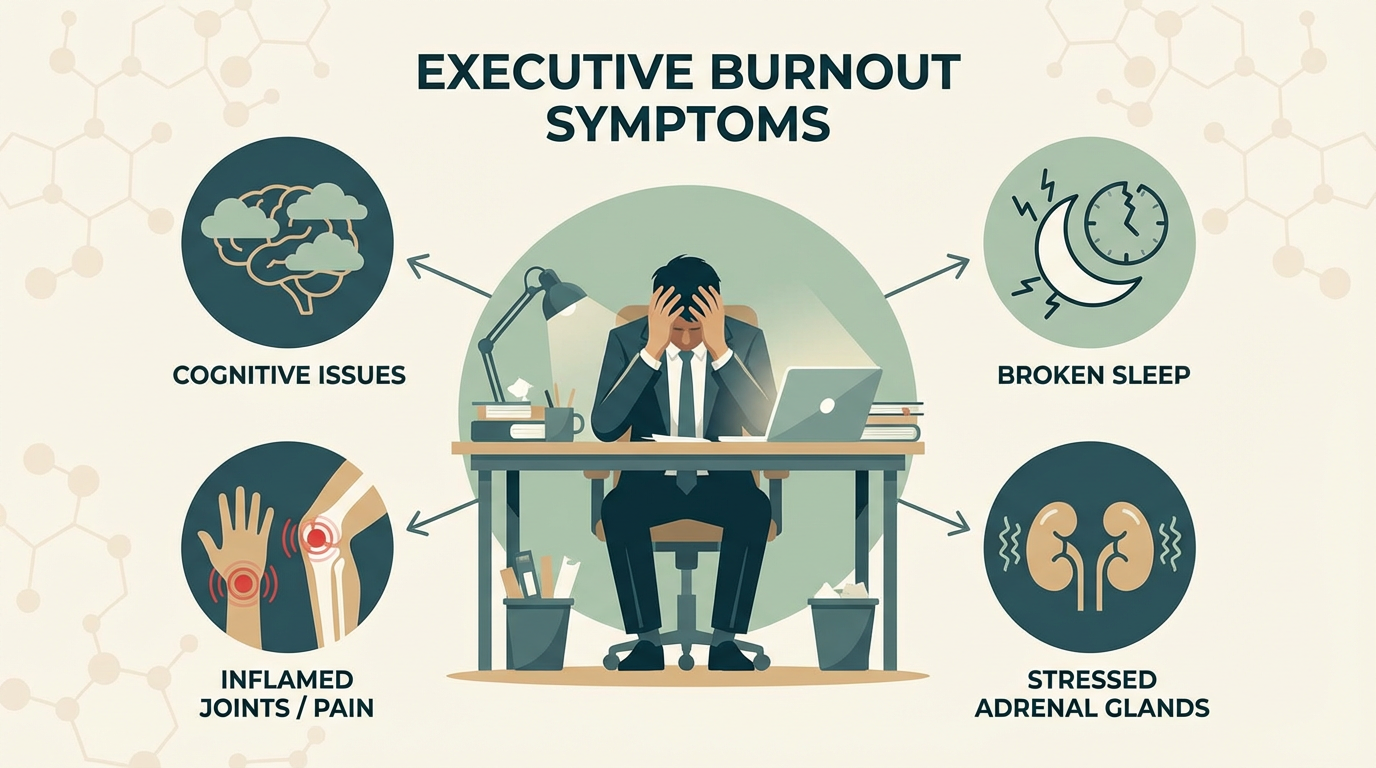
You're a high-performer. You've built your career on discipline, resilience, and pushing through. But lately, the engine isn't responding. You wake up exhausted. Your brain feels foggy. Simple decisions feel monumental. Coffee doesn't help anymore.
Your doctor says your labs are "normal." Friends tell you to take a vacation, practice self-care, or adjust your mindset. But deep down, you know this isn't about needing a break or thinking more positively.
This is biological. And it's measurable.
Critical Insight: When we test executives in burnout, we consistently see flattened cortisol curves, low DHEA, elevated inflammatory markers, thyroid suppression, and neurotransmitter imbalances. This isn't "all in your head"—these are objective biomarkers.
Executive Burnout Isn't a Mindset Problem—It's a Biology Problem
The World Health Organization now recognizes burnout as an "occupational phenomenon"—but that doesn't capture what's actually happening in your body. When we test executives in burnout, we consistently see the same pattern:
- Flattened cortisol curves (your stress response is exhausted)
- Low DHEA (your resilience hormone is depleted)
- Elevated inflammatory markers (chronic stress creates chronic inflammation)
- Thyroid suppression (your metabolism is protecting you by slowing down)
- Neurotransmitter imbalances (dopamine and serotonin production can't keep up)
This isn't "all in your head." These are objective biomarkers showing your body's stress-response system has been overdriven to the point of dysfunction.
The Burnout Cascade:
Chronic stress → HPA axis dysfunction → hormonal depletion → inflammation → metabolic slowdown → exhaustion, brain fog, emotional flatness
Each stage is measurable. Each stage is reversible.
The Three Stages of Burnout Biology
Stage 1: The Overdrive Phase (Wired and Tired)
In the early phase, cortisol is elevated—especially at night when it should be low. You're "wired but tired." You can still perform, but you need stimulants to start and alcohol or sleep aids to stop. Your body is running on adrenaline.
What we measure:
- Elevated evening cortisol
- High cortisol-to-DHEA ratio
- Sleep architecture disruption
- Rising fasting insulin
Stage 2: The Depletion Phase (Running on Empty)
Your adrenals can't keep up anymore. Cortisol output drops. You feel exhausted but can't sleep deeply. Brain fog sets in. Motivation disappears. This is classic HPA axis dysfunction.
What we measure:
- Flattened cortisol curve (low morning, low throughout day)
- DHEA suppression
- Elevated CRP or homocysteine
- Low testosterone (even in men)
- Thyroid conversion problems (low Free T3)
Stage 3: The Crash (Full System Shutdown)
This is where executives end up taking medical leave. Everything feels hard. Getting out of bed requires willpower you don't have. Emotions are either numb or overwhelming. Your body has forced a shutdown to prevent complete system failure.
What we measure:
- Cortisol output barely detectable
- Multiple hormone deficiencies
- Severe inflammation
- Gut dysfunction (dysbiosis, increased intestinal permeability)
- Mitochondrial dysfunction markers
What Standard Testing Misses
Your annual physical won't catch burnout. A single-point cortisol test at 8 AM doesn't show the pattern. Standard thyroid panels don't include Free T3 or Reverse T3. Your doctor checks "stress" with a questionnaire, not biomarkers.
Functional testing reveals the biology:
- DUTCH Complete (Dried Urine Test for Comprehensive Hormones) - Maps your cortisol pattern across the day, measures DHEA, evaluates hormone metabolism
- Thyroid Panel (TSH, Free T3, Free T4, Reverse T3, antibodies) - Shows if your metabolism is suppressed
- Inflammatory Markers (CRP, homocysteine, ferritin) - Quantifies chronic inflammation
- Metabolic Panel (Fasting insulin, glucose, HbA1c, lipids) - Reveals metabolic stress
- Nutrient Status (Vitamin D, B12, magnesium, iron) - Identifies depletion
- Neurotransmitter Testing (optional) - For severe mood and motivation issues
Why This Matters: You can't fix what you can't measure. Testing shows exactly which systems are impaired and guides personalized recovery.
The Reversal Protocol: Turning Biology Back Online
Once we have your data, recovery becomes systematic. This isn't about rest alone—it's about restoring function at the biological level.
1. HPA Axis Restoration
Support your stress-response system:
- Adaptogenic herbs - Ashwagandha, rhodiola, holy basil (dosed based on cortisol pattern)
- Phosphatidylserine - Lowers elevated evening cortisol
- Licorice root - Extends cortisol half-life (only if cortisol is low)
- Strategic nutrition - Blood sugar stability to reduce cortisol spikes
2. Inflammation Management
Calm the fire:
- Omega-3 fatty acids (EPA/DHA) - Reduce inflammatory cytokines
- Curcumin - Powerful anti-inflammatory
- Remove inflammatory triggers - Processed foods, excess alcohol, hidden food sensitivities
3. Metabolic Repair
Restore energy production:
- Mitochondrial support - CoQ10, PQQ, alpha-lipoic acid, B-complex
- Thyroid optimization - If Free T3 is low or Reverse T3 is high
- Blood sugar regulation - Protein-first meals, strategic carb timing
4. Neurotransmitter Restoration
Rebuild motivation and mood:
- Amino acid precursors - L-tyrosine for dopamine, 5-HTP or L-tryptophan for serotonin
- Methylated B vitamins - B6, B9 (methylfolate), B12 (methylcobalamin)
- Magnesium - Critical for neurotransmitter synthesis and sleep
5. Sleep Architecture Recovery
Deep sleep is when repair happens:
- Circadian alignment - Morning light exposure, evening light reduction
- Sleep supplements - Magnesium glycinate, L-theanine, apigenin
- Screen cutoff - Blue light suppresses melatonin; stop 2 hours before bed
Recovery Timeline
Recovery Timeline (with proper support):
- 2–4 weeks: Sleep starts improving, energy slightly better
- 6–8 weeks: Brain fog lifts, motivation returns
- 3–6 months: Hormones normalize, full energy restored
- 6–12 months: Resilience rebuilt, stress response healthy again
Why Generic "Wellness" Advice Doesn't Work
Burnout recovery isn't the same for everyone. Your cortisol pattern is unique. Your inflammation drivers are specific to you. Your nutrient depletions are individual.
Generic advice like "take magnesium and meditate" might help someone in Stage 1. But if you're in Stage 3 with crashed cortisol and thyroid suppression, you need targeted intervention based on your data.
That's why we test.
The Executive Advantage: Data-Driven Recovery
You make business decisions based on data. Why would you approach your health any differently?
When you test, you know:
- Exactly which systems are impaired
- What doses and supplements you actually need
- When you're recovering (by retesting)
- How to prevent relapse (by monitoring markers)
This is precision medicine. Not guesswork. Not one-size-fits-all protocols. Your biology, your data, your recovery plan.
Medical Disclaimer: This article is for educational purposes only and not a substitute for professional medical advice. Consult a qualified healthcare provider before starting any supplement or treatment protocol.
Ready to Reverse Executive Burnout?
Let's measure your biology, identify what's broken, and turn it back online.
Book a free 15-minute discovery call. We'll discuss whether functional testing is the right next step for your burnout recovery—no pressure, just information.
Book Your Free Discovery CallNo sales pitch. Just an honest conversation about your health.