"Your labs look normal. Everything's fine." You leave the doctor's office feeling dismissed, confused, and frankly, gaslit. Because you know something's wrong. You feel exhausted every day. You can't sleep. Your brain feels foggy. You ache in ways that don't make sense. But according to the blood test, you're "fine."
Here's the truth nobody's telling you: Standard lab testing is designed to catch disease, not optimize performance.
The ranges your doctor uses are based on population averages—including sick people. They're built to identify when you're sick enough to need medical intervention, not when you're struggling in the "grey zone" between optimal and diseased.
The Problem with "Normal" Reference Ranges
Let's talk about TSH (thyroid stimulating hormone) as an example.
The standard reference range is approximately 0.4 - 4.5 mIU/L. If your TSH is 4.2, your doctor says you're normal. But here's what they don't tell you:
| TSH Level | Status |
|---|---|
| 1.0 - 2.0 mIU/L | Functional optimal range |
| Above 2.5 mIU/L | Many experience fatigue, weight gain, brain fog |
| 4.2 mIU/L | Technically "normal" but functionally hypothyroid |
You're exhausted, gaining weight despite diet and exercise, your hair is thinning, and you're freezing all the time—but you're told you're fine because you haven't crossed into disease territory yet.
The Fundamental Flaw
Standard medicine waits for you to get sick enough to treat. Functional medicine optimizes before you reach that point.
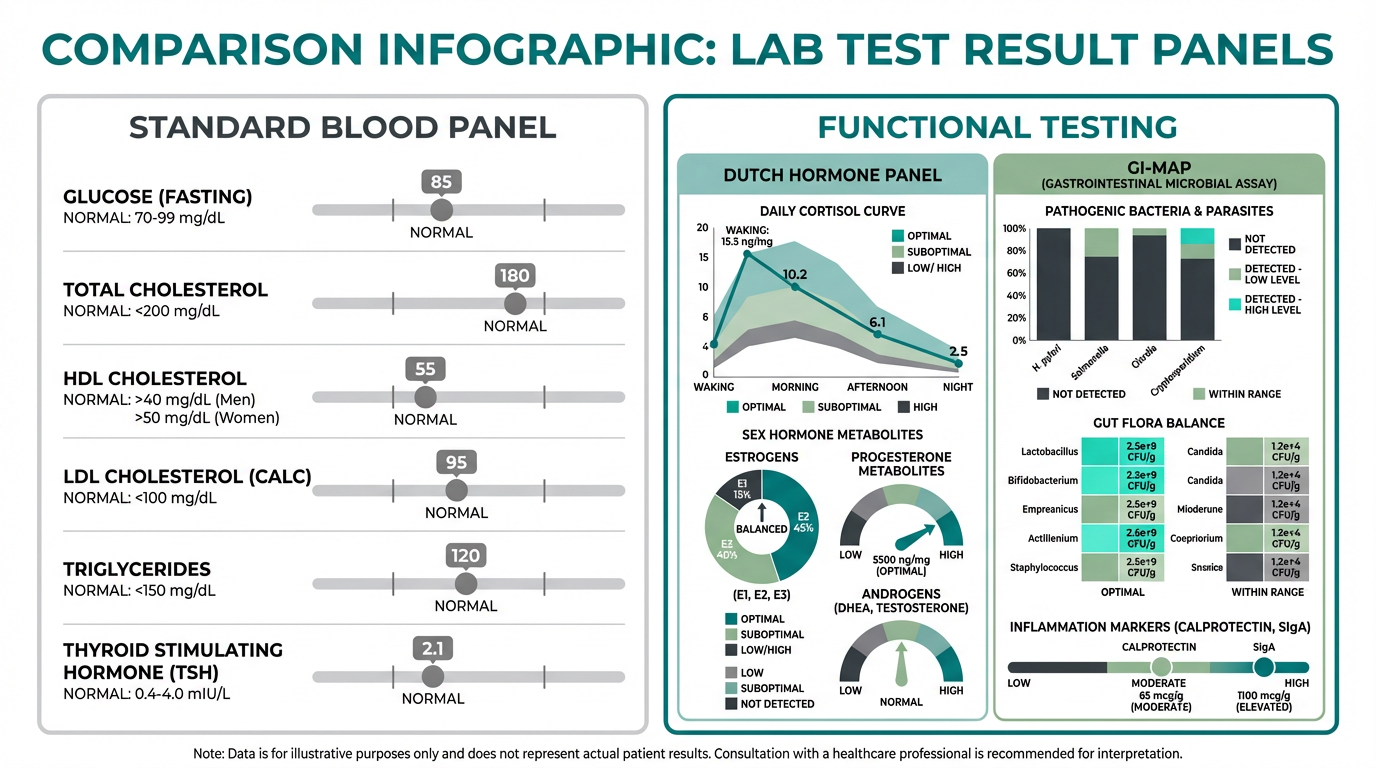
What Standard Blood Panels Actually Test
When your doctor orders "comprehensive labs," they typically include:
- CBC (Complete Blood Count): Red/white blood cells, hemoglobin, platelets
- CMP (Comprehensive Metabolic Panel): Glucose, electrolytes, kidney/liver function
- Lipid Panel: Total cholesterol, LDL, HDL, triglycerides
- TSH: Basic thyroid screening (often just TSH, not full thyroid panel)
These tests are excellent for catching:
- Anemia
- Diabetes
- Kidney disease
- Liver disease
- Severe thyroid dysfunction
But they miss:
- Hormone dysregulation (cortisol patterns, sex hormones, complete thyroid picture)
- Micronutrient deficiencies (vitamin D, B12, magnesium, iron stores)
- Inflammation markers (hs-CRP, homocysteine)
- Gut health (microbiome composition, inflammatory markers, digestive function)
- Metabolic dysfunction (insulin resistance, hemoglobin A1C isn't always included)
- Oxidative stress and detoxification capacity
What Functional Testing Reveals
Functional medicine practitioners use advanced testing to see what standard panels miss. Here are the game-changers:
1. DUTCH Complete Hormone Testing
This test measures:
- Cortisol patterns throughout the day (not just one morning snapshot)
- Sex hormones (estrogen, progesterone, testosterone) and their metabolites
- Neurotransmitter metabolites (serotonin, dopamine pathways)
- Melatonin production (sleep hormone)
- Organic acids (B-vitamin status, oxidative stress)
What It Catches
Adrenal dysfunction, hormone imbalances, sleep disruption causes, stress resilience depletion—none of which show up in standard testing.
2. GI-MAP Stool Analysis
This DNA-based test reveals:
- Microbiome composition (beneficial bacteria levels, pathogenic overgrowth)
- Gut inflammation (calprotectin)
- Intestinal permeability (zonulin—"leaky gut" marker)
- Immune function (secretory IgA)
- Digestive capacity (pancreatic elastase, fat absorption)
- Opportunistic infections (H. pylori, Candida, parasites)
What It Catches
Dysbiosis causing brain fog, inflammation driving pain, digestive issues causing nutrient malabsorption—again, invisible to standard testing.
3. Comprehensive Nutrient Testing
Beyond just checking for severe deficiency, functional testing examines:
- Intracellular nutrients (what's actually inside your cells, not just in your blood)
- Methylation markers (MTHFR gene considerations, homocysteine)
- Amino acid profiles (building blocks for neurotransmitters)
- Fatty acid balance (omega-3 to omega-6 ratios)
What It Catches
Subclinical deficiencies affecting energy, mood, cognitive function, and recovery.
Real Example: "Normal" vs. Optimal
Let's look at a real client's results (identifying details changed):
Standard Lab Results
- TSH: 3.8 (Normal: 0.4-4.5)
- Fasting glucose: 95 (Normal: 70-100)
- Vitamin D: 32 (Normal: 30-100)
- All other markers: Normal
Doctor's conclusion: "Everything looks fine."
Functional Assessment
- TSH 3.8 + Free T3 low-normal: Subclinical hypothyroidism
- Fasting glucose 95 + Fasting insulin 18: Early insulin resistance
- Vitamin D 32: Deficient for optimal immune function (optimal: 50-80)
- DUTCH test: Inverted cortisol curve
- GI-MAP: Low Bifidobacterium, elevated zonulin, low secretory IgA
The real picture: Thyroid dysfunction, metabolic dysregulation, vitamin D insufficiency, adrenal stress, and gut dysfunction driving inflammation.
All of this was invisible to standard testing.
Why Doctors Don't Order These Tests
This isn't your doctor's fault. They're working within a system designed for disease management, not performance optimization. Insurance companies won't pay for "optimization"—only for treating diagnosed conditions.
Additionally:
- Medical training focuses on pathology (disease), not functional optimization
- 15-minute appointments don't allow time for deep investigation
- Insurance reimbursement doesn't cover functional testing
- Standard of care guidelines dictate what tests are "medically necessary"
Your doctor isn't dismissing you—they're constrained by a system not built for what you need.
When Should You Consider Functional Testing?
Functional testing is ideal if:
- Your labs are "normal" but you feel terrible
- You have multiple unexplained symptoms (fatigue, brain fog, sleep issues, pain, mood problems)
- You've tried conventional treatments without improvement
- You want to optimize performance, not just avoid disease
- You're willing to invest in understanding your biology deeply
What Happens Next?
Once you have comprehensive data, you can build a personalized protocol targeting YOUR specific dysfunctions:
- Thyroid support (if needed: selenium, iodine, T3 conversion support)
- Blood sugar stabilization (if needed: dietary changes, berberine, chromium)
- Adrenal restoration (if needed: adaptogens, phosphatidylserine, lifestyle modification)
- Gut healing (if needed: targeted probiotics, anti-inflammatory support, food sensitivity management)
- Nutrient repletion (if needed: specific supplementation based on actual deficiencies)
This is personalized medicine—protocols built for your unique biology, not generic advice.
The Bottom Line
Remember This
"Normal" doesn't mean optimal. It means you're not sick enough—yet.
If you're tired of being told everything's fine when you know it's not, it's time to test deeper. Your body is giving you signals. The question is: are you using the right tools to decode them?
Ready to See What Standard Testing Is Missing?
Book a free 15-minute discovery call. We'll discuss whether functional testing is the right next step for you—no pressure, just information.
Book Your Free Discovery CallNo sales pitch. Just an honest conversation about your health.