It's 3:17 AM. You're wide awake. Again. Your mind is racing. Your heart might be pounding slightly. You feel wired, anxious, maybe even a little panicked. You didn't have caffeine late. You're not stressed about anything specific. But like clockwork, you wake up between 2–4 AM, and you can't get back to sleep.
This isn't insomnia. This isn't "just stress." This is cortisol dysregulation—and it's measurable.
What Is Cortisol and Why Does It Matter?
Cortisol is your primary stress hormone, produced by your adrenal glands. It's not inherently bad—in fact, you need it to survive. Cortisol:
- Wakes you up in the morning
- Regulates blood sugar
- Controls inflammation
- Supports your immune system
- Helps you respond to stress
The problem isn't cortisol itself—it's when your cortisol rhythm gets disrupted.
The Healthy Cortisol Pattern
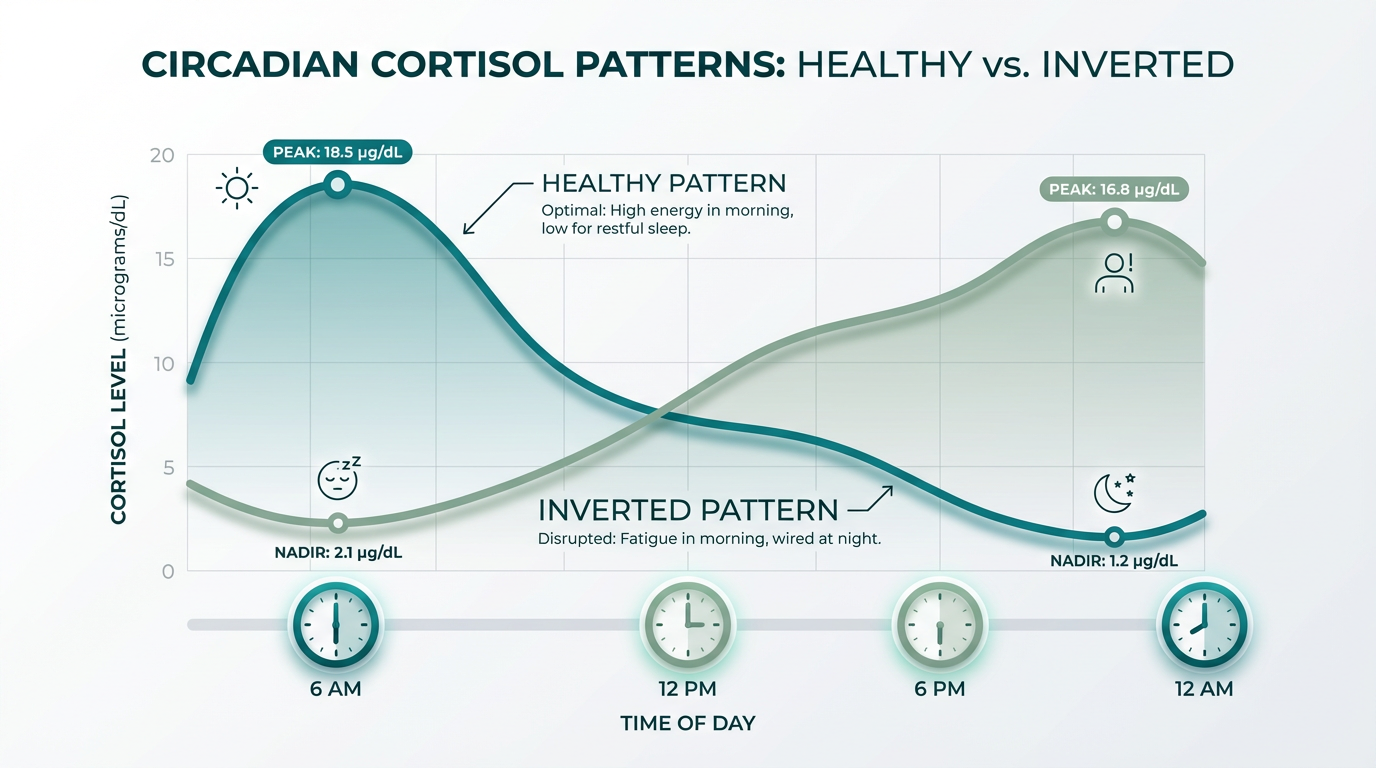
In a healthy system, cortisol follows a predictable daily rhythm (called the diurnal rhythm or circadian cortisol curve):
Healthy Cortisol Rhythm
- 6–8 AM: Cortisol peaks (this is what wakes you up naturally)
- Mid-morning: Cortisol starts declining
- Afternoon: Cortisol continues to drop
- Evening: Cortisol is low (allowing melatonin to rise for sleep)
- Midnight–4 AM: Cortisol is at its lowest
This pattern allows you to feel energized in the morning, steady throughout the day, and calm enough to sleep deeply at night.
The Key Insight
It's not about how much cortisol you have—it's about when you have it.
The Inverted Cortisol Pattern (Why You Wake at 3 AM)
When your body experiences chronic stress, your cortisol rhythm flips. Instead of high in the morning and low at night, you get:
Inverted Cortisol Pattern
- Morning: Low cortisol (you wake up exhausted, need coffee immediately)
- Afternoon: Slight rise (you get a second wind around 3–5 PM)
- Evening: Cortisol climbs higher (you feel wired at night when you should be winding down)
- 2–4 AM: Cortisol spikes (your body thinks it's morning—this wakes you up)
This is called an inverted cortisol curve, and it's the biological reason you wake up at 3 AM with your mind racing.
What Causes an Inverted Cortisol Pattern?
Chronic stress is the driver, but the stressors can be physical, emotional, or metabolic:
- Chronic work stress (long hours, high pressure, no downtime)
- Blood sugar dysregulation (low blood sugar at night triggers a cortisol response)
- Chronic inflammation (from gut dysfunction, food sensitivities, or underlying infections)
- Over-exercising without adequate recovery
- Sleep deprivation itself (creates a vicious cycle)
- Emotional stress or unresolved trauma
Your body doesn't distinguish between these stressors—it just knows it's under siege, and it keeps cortisol elevated to keep you "safe."
How to Test Your Cortisol Pattern
You can't see cortisol dysregulation on standard blood work. A single morning cortisol test won't show the pattern—you need to measure cortisol throughout the day.
The Gold Standard: DUTCH Complete Test
The DUTCH (Dried Urine Test for Comprehensive Hormones) measures cortisol at four time points throughout the day:
- Morning (waking)
- Mid-morning
- Afternoon
- Evening (before bed)
This creates a cortisol curve that shows exactly when your cortisol is high, when it's low, and whether your pattern is healthy or inverted.
The DUTCH test also measures:
- DHEA (your resilience hormone)
- Melatonin (your sleep hormone)
- Cortisol metabolites (how you're processing cortisol)
- Sex hormones (estrogen, progesterone, testosterone)
Why This Matters
Once you see your cortisol pattern on paper, you can fix it with precision. No more guessing.
How to Fix an Inverted Cortisol Pattern
Fixing cortisol dysregulation takes time—usually 3–6 months—but it's absolutely doable. Here's the protocol:
1. Stabilize Blood Sugar
Low blood sugar at night is a major trigger for cortisol spikes. Fix this first:
- Eat protein with every meal (30–40g per meal)
- Don't skip meals, especially breakfast
- Have a small protein/fat snack 1–2 hours before bed
- Limit refined carbs and sugars
2. Use Adaptogenic Herbs
Adaptogens help modulate cortisol—raising it when it's too low, lowering it when it's too high:
- Ashwagandha (take at night to lower evening cortisol)
- Rhodiola (take in the morning to support healthy morning cortisol)
- Holy Basil (helps regulate cortisol throughout the day)
- Phosphatidylserine (specifically lowers elevated nighttime cortisol)
3. Prioritize Sleep Hygiene
- Consistent sleep/wake times (even on weekends)
- Morning sunlight exposure (resets your circadian rhythm)
- Block blue light after sunset (wear blue-light-blocking glasses)
- Cool, dark bedroom (65–68°F is optimal)
- No screens 1–2 hours before bed
4. Manage Stress (For Real)
This isn't about bubble baths. This is about nervous system regulation:
- Breathwork (4-7-8 breathing, box breathing)
- Meditation or mindfulness (even 5–10 minutes daily)
- Walking in nature (lowers cortisol measurably)
- Set boundaries (stop checking work email at 9 PM)
5. Support with Targeted Supplements
- Magnesium glycinate (400–600 mg before bed—calms the nervous system)
- L-theanine (200–400 mg—promotes relaxation without sedation)
- Phosphatidylserine (300 mg before bed—lowers nighttime cortisol)
- Vitamin B5 and B6 (support adrenal function)
Recovery Timeline
2–4 weeks: You'll start sleeping more consistently
6–8 weeks: Morning energy improves, nighttime waking decreases
3–6 months: Cortisol pattern normalizes (confirmed by retesting)
The Bottom Line
If you're waking up at 3 AM every night, it's not random. It's not "just stress." It's a cortisol pattern that's out of sync—and it's fixable.
The first step is testing. Once you see your cortisol curve, you can address the root cause with precision.
You don't have to live like this.
Ready to Fix Your Cortisol Pattern?
Let's test your cortisol curve and build a personalized protocol to restore your sleep.
Schedule Your Free Discovery Call