You've tried therapy. You've tried meditation. You've tried SSRIs. But the anxiety still lingers. The brain fog won't lift. Your mood swings are unpredictable. You're exhausted, irritable, and nothing seems to help.
What if the problem isn't in your head? What if it's in your gut?
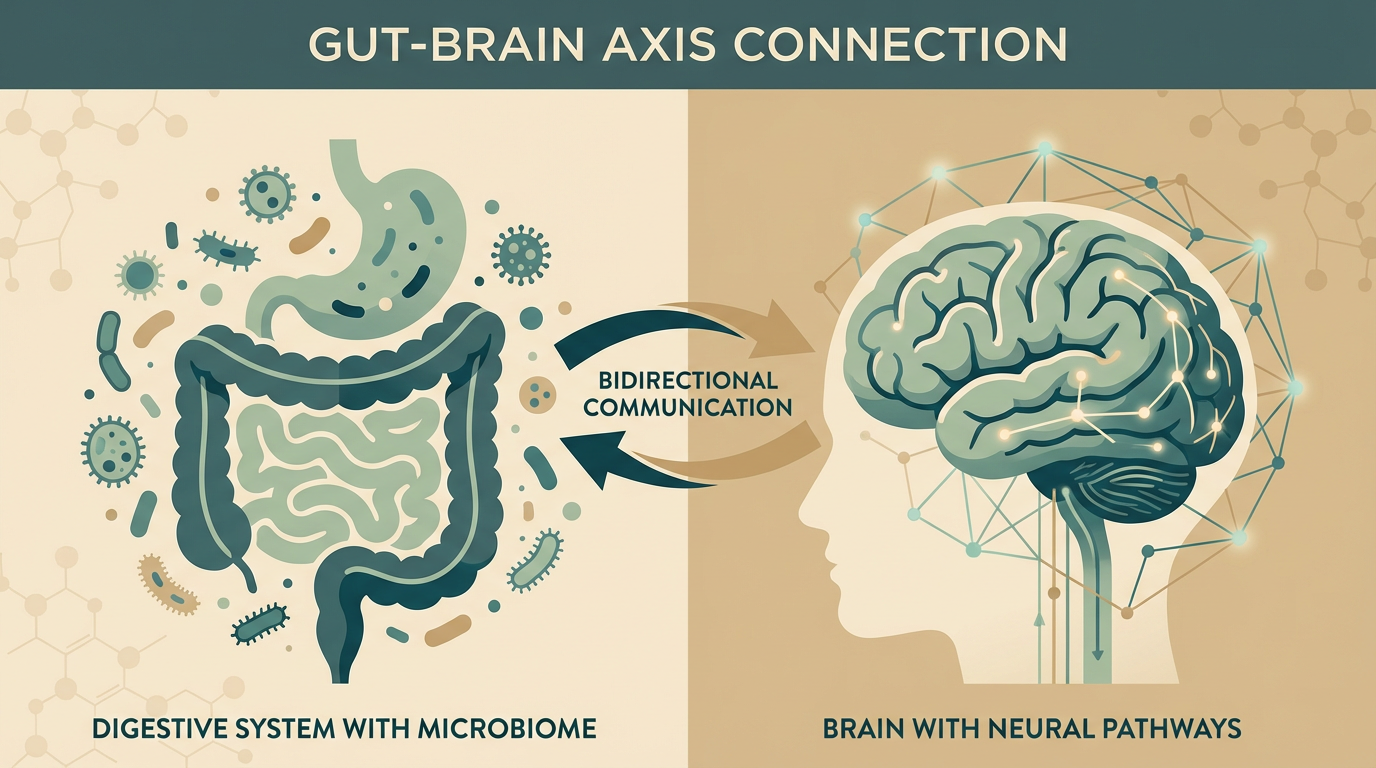
The gut-brain connection is one of the most significant discoveries in modern health science. Your gut and brain are in constant communication through the gut-brain axis—and when your gut is dysfunctional, your mental health suffers.
Key Insight: 90% of your serotonin is produced in your gut—not your brain. When your gut microbiome is imbalanced, your mental health suffers.
What Is the Gut-Brain Axis?
The gut-brain axis is a bidirectional communication network linking your gut and brain. It involves:
- The vagus nerve (a direct nerve connection)
- Neurotransmitters (produced in the gut)
- The immune system (70% of which lives in your gut)
- The microbiome (trillions of bacteria influencing brain chemistry)
- Hormones and inflammatory signals
Your gut microbiome—the trillions of bacteria living in your intestines—directly influences your mood, cognition, stress response, and mental health.
Key Insight
Your gut is often called your "second brain" because it produces the same neurotransmitters your brain uses—serotonin, dopamine, GABA.
Your Gut Makes Your Neurotransmitters
Here's something most people don't know: 90% of your serotonin is produced in your gut.
Your gut bacteria produce and regulate key neurotransmitters:
- Serotonin: The "feel-good" neurotransmitter. Low serotonin = depression, anxiety, irritability
- GABA: The calming neurotransmitter. Low GABA = anxiety, racing thoughts, insomnia
- Dopamine: The motivation neurotransmitter. Low dopamine = lack of drive, brain fog, apathy
- Acetylcholine: Memory and focus. Low levels = cognitive decline, poor memory
When your gut microbiome is imbalanced (dysbiosis), neurotransmitter production gets disrupted. The result? Anxiety, depression, brain fog, mood swings—even though there's "nothing wrong" with your brain.
Critical Point: Treating depression and anxiety without addressing gut health is like treating a leaking pipe by mopping the floor—you're not fixing the source.
The Vagus Nerve: The Highway Between Gut and Brain
The vagus nerve is the main communication line between your gut and brain. It's a two-way street:
- Bottom-up signaling: Your gut sends signals to your brain about inflammation, nutrients, and bacterial balance
- Top-down signaling: Your brain sends signals to your gut affecting digestion, motility, and immune function
When your gut is inflamed or dysbiotic, the vagus nerve transmits inflammatory signals to the brain. This creates:
- Anxiety and panic
- Depression and low mood
- Brain fog and cognitive dysfunction
- Sleep disruption
The vagus nerve is why gut dysfunction doesn't just affect digestion—it affects your entire mental state.
How Dysbiosis Causes Anxiety and Depression
Dysbiosis is an imbalance in your gut bacteria—too many harmful bacteria, not enough beneficial ones. This imbalance drives mental health issues in several ways:
1. Reduced Neurotransmitter Production
Beneficial bacteria (like Lactobacillus and Bifidobacterium) produce GABA, serotonin precursors, and other mood-regulating compounds. When these bacteria are depleted, neurotransmitter production drops.
2. Increased Inflammation
Harmful bacteria produce inflammatory compounds (LPS—lipopolysaccharides) that trigger systemic inflammation. Inflammation is strongly linked to depression and anxiety.
3. Leaky Gut and Brain Inflammation
Dysbiosis damages the gut lining, causing intestinal permeability (leaky gut). This allows bacteria, toxins, and undigested food particles to enter the bloodstream, triggering immune responses and brain inflammation.
4. HPA Axis Dysregulation
Dysbiosis disrupts the HPA axis (hypothalamic-pituitary-adrenal axis), leading to cortisol dysregulation. Result: chronic stress, anxiety, and burnout.
The Research
Studies show that people with depression and anxiety have distinctly different gut microbiomes compared to healthy individuals. Fixing the gut often fixes the mood.
Leaky Gut = Leaky Brain
When your gut lining becomes permeable (leaky gut), it doesn't just affect digestion—it affects your brain.
What causes leaky gut?
- Chronic stress
- Poor diet (refined sugars, processed foods, gluten, dairy)
- Alcohol
- NSAIDs (ibuprofen, aspirin) and antibiotics
- Gut infections (SIBO, Candida, parasites)
- Food sensitivities
When the gut barrier is compromised, inflammatory particles cross into the bloodstream. These particles can cross the blood-brain barrier, causing neuroinflammation.
Neuroinflammation drives:
- Depression
- Anxiety
- Brain fog
- Memory issues
- Cognitive decline
Healing the gut lining reduces systemic inflammation and protects the brain.
How to Test Your Gut Health
You can't guess your way to gut health. Testing is essential.
The Gold Standard: GI-MAP Stool Test
The GI-MAP (Gastrointestinal Microbial Assay Plus) is a DNA-based stool test that reveals:
- Bacterial balance: Beneficial bacteria (Lactobacillus, Bifidobacterium) vs. pathogenic overgrowth
- Gut inflammation: Calprotectin levels
- Intestinal permeability: Zonulin (the marker for leaky gut)
- Digestive function: Pancreatic elastase, fat absorption
- Immune function: Secretory IgA
- Infections: H. pylori, Candida, parasites, C. difficile
This test shows exactly what's happening in your gut—so you can fix it with precision.
Why This Matters: Once you know what's wrong, you can target the exact imbalance. No more guessing with random probiotics.
How to Heal the Gut-Brain Axis
Healing the gut-brain connection takes time—usually 3–6 months—but it's absolutely doable. Here's the protocol:
1. Remove the Triggers
Dietary:
- Eliminate refined sugars and processed foods
- Remove gluten and dairy (trial for 30 days)
- Avoid inflammatory seed oils
- Identify food sensitivities (consider IgG testing)
Lifestyle:
- Reduce chronic stress (meditation, breathwork, therapy)
- Minimize alcohol
- Avoid unnecessary antibiotics and NSAIDs
2. Eradicate Infections
If testing reveals infections (H. pylori, SIBO, Candida, parasites), treat them:
- H. pylori: Triple or quadruple antibiotic therapy (or natural antimicrobials)
- SIBO: Rifaximin or herbal antimicrobials + low-FODMAP diet
- Candida: Antifungals (fluconazole or natural options like caprylic acid, oregano oil)
- Parasites: Antiparasitic medications or herbal protocols
3. Rebuild the Microbiome
- Probiotics: Multi-strain formulas with Lactobacillus and Bifidobacterium (50+ billion CFU)
- Prebiotics: Feed beneficial bacteria (inulin, resistant starch, FOS)
- Fermented foods: Sauerkraut, kimchi, kefir, yogurt
- Polyphenols: Berries, green tea, dark chocolate (feed beneficial bacteria)
4. Heal the Gut Lining
- L-glutamine: 5–10g daily (repairs gut lining)
- Zinc carnosine: 75–150mg daily (heals mucosal damage)
- Collagen or bone broth: Provides amino acids for gut repair
- Omega-3 fatty acids: 2–3g EPA/DHA daily (reduces inflammation)
- Aloe vera or slippery elm: Soothes and heals gut lining
5. Support Neurotransmitter Production
- Vitamin B6: Cofactor for serotonin and GABA production
- Magnesium: 400–600mg daily (calms nervous system, supports GABA)
- 5-HTP or L-tryptophan: Serotonin precursors (if serotonin is low)
- L-tyrosine: Dopamine precursor (if dopamine is low)
6. Strengthen Vagal Tone
Improve gut-brain communication:
- Deep breathing exercises
- Cold exposure (cold showers)
- Singing or humming
- Gargling
- Meditation and mindfulness
Gut Healing Timeline
- 2–4 weeks: Digestion improves, bloating decreases
- 6–8 weeks: Mood stabilizes, anxiety reduces
- 3–6 months: Full gut-brain restoration, mental clarity returns
The Bottom Line
If you've been struggling with anxiety, depression, or brain fog—and nothing seems to help—it's time to look at your gut.
The gut-brain connection is real, measurable, and fixable. Test your gut, identify the imbalances, and heal the root cause.
Your mental health starts in your gut.
Medical Disclaimer: This article is for educational purposes only and not a substitute for professional medical advice. Consult a qualified healthcare provider before starting any supplement or treatment protocol.
Ready to Heal Your Gut-Brain Axis?
Let's test your gut microbiome and build a personalized protocol to restore your mental health from the inside out.
Book a free 15-minute discovery call. We'll discuss whether gut testing is the right next step for you—no pressure, just information.
Book Your Free Discovery CallNo sales pitch. Just an honest conversation about your health.